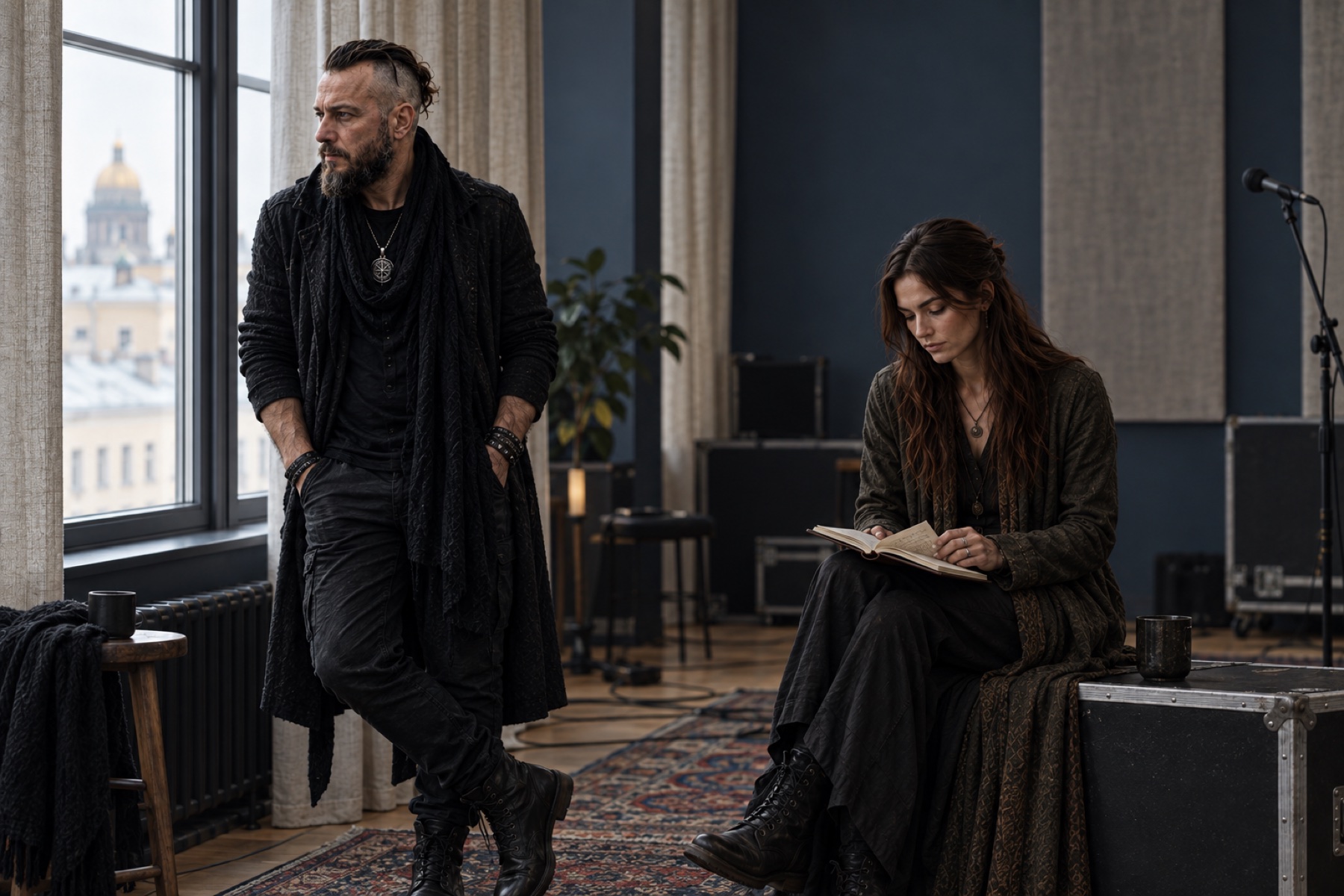
Two people instead of one narrator
Most songs have a single centre of gravity: one person tells us what happened, and the listener accepts that account. Yarveya works differently. Yar’s baritone and Veya’s female voice allow one story to hold two points of view. At times they share a chorus after arriving there by different routes. Elsewhere one voice begins a thought and the other changes its meaning with a reply. When they separate into solo songs, the missing interlocutor becomes part of the story.
Yar is associated with roads, movement and the experience of someone who keeps going without receiving every answer. Veya is more attentive to memory, detail and what remains after an event. These are not rigid assignments: Yar can be openly vulnerable, while Veya can make the decision that moves a story forward. The difference serves a practical purpose. Each voice notices something the other might miss, creating depth without an all-knowing narrator.
The songs do not depend on one fixed biography for the relationship between Yar and Veya. Each composition establishes its own situation. What persists is the presence of two adults, neither of whom has to deliver the final verdict. Dialogue in Yarveya is therefore more than a vocal arrangement or a contrast between timbres. It preserves the fact that two people can live through the same moment differently.
How the dialogue works on Once
The first album introduces this method immediately. In the title track, Veya watches a city going to sleep: an unlocked door, unsent messages and people waiting for a simple answer. Yar enters later through trains, taxis and the memory of someone’s name. They observe the same sleepless night from different distances before meeting in a final thought about words left unsaid. The two voices function like an edit: personal observation, a second angle, then a shared conclusion.
Ничего не искал makes the structure even clearer. Yar and Veya take turns describing an unexpected meeting. He had been hiding in the noise of a crowd; she had arrived after a difficult week. He remembers the instant an ordinary evening changed, while she remembers the rare feeling of lightness. The chorus belongs to both because the meeting exists in the overlap between their accounts. The listener hears more than either character could tell alone.
Не удерживать moves the conversation from the present into memory. Yar speaks about roads and unfinished conversations; Veya considers how memory can illuminate what happened without dragging a person backwards. Their positions are close, though their tones differ. In Следы, the distinction becomes physical: Yar leaves footprints so that he can remember his direction, while Veya holds on to the trace after the snow covers it. The brief exchange of questions and answers depends on both voices; remove either one and half the movement disappears.
What the solo songs reveal
After four duets, Once changes its distance. Ещё утро не скоро belongs entirely to Veya. Ivan Bunin’s text contains no argument or direct exchange: there is a forest before dawn, slow movement and the knowledge that this night will not return. The solo voice gives the album a pause. Veya can exist without answering Yar and reveal her own way of experiencing time through observation, silence and exact detail.
Yar follows with the solo Нам другого не суждено. Its setting is different: a long city night, memory, roads and pain that must be lived through. It is a male monologue delivered by someone with enough experience to speak plainly about vulnerability. Placing the two solo songs beside one another matters more than the simple contrast between their voices. The album first shows how Yar and Veya speak together, then leaves each of them alone and listens for what remains.
The closing Мне грустно на тебя смотреть, based on a poem by Sergei Yesenin, joins them again. Yar and Veya divide the verses and meet in the refrain. Their reunion lands differently after the solo songs because the listener now recognises each voice on its own terms. They remain distinct even while singing the same words.
From personal stories to Silver Age poetry
Silver Century applies the same method to six poets from the early twentieth century. Veya opens with Любовь твоя жаждет так много after Maximilian Voloshin; Yar follows alone in Среди миров after Innokenty Annensky. The first two tracks already offer separate ways of speaking about love, giving each voice its own space, pace and degree of intimacy.
At the album’s centre is the duet Любовь, подобная вражде after Dmitry Merezhkovsky. The poetic situation itself calls for two participants: attraction exists beside disagreement, a whisper can grow into strain, and intimacy does not erase difference. The album then changes scale again, moving from Veya’s Как горько понимать to Yar’s restrained Можно жить с закрытыми глазами. Zinaida Gippius’s Слова любви brings both voices back for the closing conversation.
The source material changes between the two albums, but the project’s method remains. Once introduces Yar and Veya through contemporary city life, chance meetings, roads and memory. Silver Century gives them words from another era and asks how familiar those words can sound today. The answer comes from two present-day voices rather than historical styling. A text may be a century old; the pause, reply, disagreement and attempt to hear another person happen now.
Yar and Veya are therefore more than characters placed around a catalogue of songs. They determine how Yarveya tells a story. Where one voice might deliver a conclusion, two can leave the question open. Where a conventional duet might simply enlarge a chorus, they create a meeting between separate experiences. Yarveya’s music lives in that distance: close enough for conversation, wide enough for each voice to keep its identity.